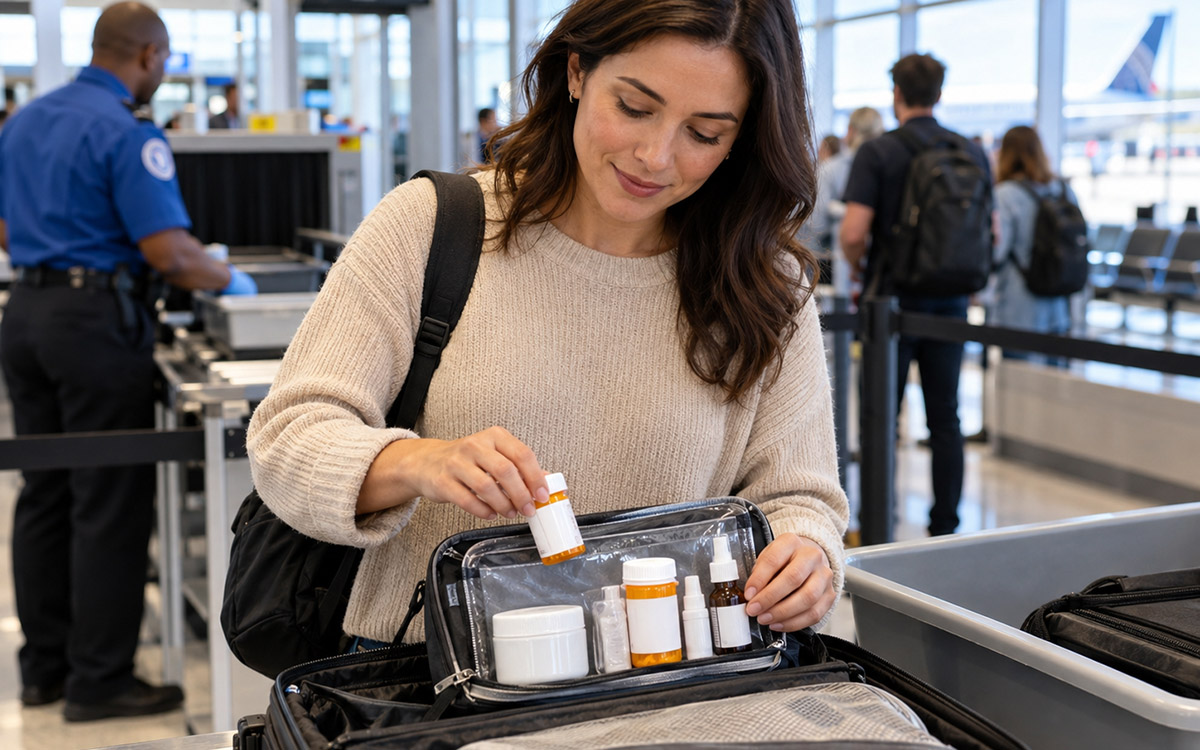
Compounded medications can fly with you. TSA allows medically necessary liquids, gels, and creams above the 3.4-ounce limit in reasonable quantities, as long as you tell the officer at the checkpoint. Pack everything in your carry-on in the original pharmacy-labeled containers. Check beyond-use dates and storage needs before you leave. Order refills early because the holidays are busy. Ask your prescriber how to handle time-zone changes, and check embassy rules before international trips.
You’re in the security line with a 4-ounce jar of compounded hormone cream in your bag, and you start to wonder whether TSA will toss it in the bin. Your compounded medications can’t be swapped for something off a store shelf, so losing them a few days before a family visit would be a real problem.
You won’t be alone in that line. TSA screened about 3.13 million people on November 30, 2025, the busiest day in its history.
Compounded medications bring a few travel challenges that standard packing lists skip. They carry a custom pharmacy label instead of a familiar brand. They often come as creams, gels, or liquids. Many have a short beyond-use date, and a refill has to be prepared by hand.
This guide from the pharmacists at King’s Pharmacy walks through airport security, packing, storage, international rules, refills, time zones, and what to do if something goes missing.
Can You Fly With Compounded Medications? What TSA Rules Say
Yes. TSA allows medically necessary liquids, gels, and aerosols in amounts larger than 3.4 ounces (100 ml), in reasonable quantities for your trip. Tell the TSA officer about them at the checkpoint. Pills and other solid medications are allowed too. Compounded creams, gels, suspensions, and drops all count as medication.
That applies to a women’s health hormone cream, a men’s health topical gel, or a child’s flavored liquid. The key is to speak up before your bag goes through the scanner.
Declare, Separate, and Expect Extra Screening
According to TSA’s guidance on medications, you should take medically necessary liquids out of your carry-on and tell the officer what they are. Items that set off an alarm are subject to additional screening. If the alarm persists, the item might be denied.
You can ask that a liquid not be X-rayed or opened. If you do, expect other screening steps, such as a pat-down and a closer look at your bag. TSA also states that screening never involves putting anything into your liquid.
Ice Packs and Cooling Accessories
If a medication needs to stay cool, TSA allows ice packs and gel packs used for medication, whether they are frozen, partly frozen, or melted. They are still screened. Syringes and other supplies that go with your medication are screened as well.
Labels Make Screening Faster
TSA notes that clear labels help screening go more smoothly. For compounded medications, the label matters even more.
Keep Original Pharmacy Labels on Compounded Medications
Keep each compounded medication in the container it came in, with the pharmacy label attached. CDC recommends original, labeled containers that show your name, your prescriber, the medication name, and the dose. With a custom preparation, the label is often the only proof of what is inside.
Why Compounded Medications Especially Need Their Labels
A brand-name inhaler is easy to recognize. A plain jar of white cream or an oral syringe of liquid looks like nothing in particular to a security officer or a customs agent. The pharmacy label is what connects that container to your prescription.
Bring Paper Backups
CDC’s advice for traveling with medicine includes carrying copies of your prescriptions, written with generic names, and leaving a copy with someone at home. A letter from your prescriber is especially useful if you travel with injectables or controlled substances.
Don’t Decant Creams Into Travel Tubes
Squeezing a cream into a travel tube removes the label, and moving a compounded preparation into a different container can affect the product itself. If a smaller size would make travel easier, call the pharmacy and ask whether a labeled travel-size container is an option for your prescription.
Pack Compounded Medications in Your Carry-On, Never Checked
Put every compounded medication in your carry-on bag. Checked luggage gets lost and delayed, and cargo holds can get very hot or freezing. A replacement compounded prescription can’t be picked up at a pharmacy near your hotel because it has to be prepared.
Lost Bags, Delays, and Replacement
CDC advises keeping medicine in your carry-on so a lost or delayed suitcase doesn’t leave you without it. Cleveland Clinic suggests packing extra in case your flight is delayed.
Road Trips Count Too
Driving to see family? A parked car can overheat in the sun or drop below freezing overnight. Keep medications in the cabin with you, not in the trunk.
“A compounded prescription can’t be replaced at the corner drugstore, so it belongs in your carry-on.”
Temperature, Storage, and Beyond-Use Dates
Every compounded preparation has a beyond-use date, or BUD. It’s the date after which the preparation should not be used. The pharmacy sets it based on USP compounding standards, and it is often shorter than the expiration date on a commercial drug.
Keep in mind that compounded drugs are not FDA-approved, so the FDA does not review their safety, effectiveness, or quality before they reach patients.
Check the BUD Before You Pack
If the beyond-use date falls during your trip, call the pharmacy before departure to talk about options. Don’t plan to stretch a preparation past its date.
Follow the Storage Line on the Label
CDC notes that extreme heat and cold can make many medicines less effective. Cleveland Clinic recommends an insulated or medical-grade cooler for refrigerated items and warns against letting medication freeze or sit directly on ice. Keep everything out of direct sun and humidity. If your label calls for strict storage, a small travel thermometer can help you keep track.
When in Doubt, Ask the Pharmacist
If a medication has been through heat or cold, or it looks different (separated, discolored, or an unusual texture), call the pharmacy before you use it.
Traveling Internationally With Compounded Medications
Before an international trip, check that each medication is legal at your destination and in every country where you have a layover. CDC advises contacting those countries’ embassies. Some medicines that are legal in the US are restricted or banned abroad, even when you have a valid prescription.
Controlled Substances and Restricted Ingredients
The CDC Yellow Book points out that a medicine that isn’t controlled in the US may still be prohibited in another country. It cites a warning from the US Embassy in Japan that travelers can be arrested for carrying banned substances, even with a US prescription. Some countries allow certain medicines only in limited amounts or with permission arranged in advance.
The International Narcotics Control Board posts country requirements for narcotic and psychotropic medicines, though the Yellow Book cautions that its listings may be out of date. Some compounded preparations, including certain hormones, may contain controlled ingredients. Ask your pharmacist whether anything you take is a scheduled substance before you book.
Documents to Carry
Bring a letter from your prescriber that lists each medication by its generic name and explains why you take it. Some countries also require a certificate from a health authority. The CDC warns that breaking a country’s medication rules can lead to confiscation, fines, or even jail.
Don’t Plan to Buy Replacements Abroad
The CDC cautions that counterfeit medicines are common in some countries and recommends bringing what you need from home. A custom formulation would be difficult to match overseas anyway.
Refill Early and Plan Around Holiday Pharmacy Hours
Compounded medications are prepared to order, so a refill takes longer than pulling a bottle off a shelf. Add holiday closures, shipping delays, and busy prescriber offices, and the timeline stretches further.
Count your supply against the length of your trip, plus a buffer for delays. CDC notes that some insurers cover only a 30-day supply at a time, so longer trips may need extra planning.
Then request your refill as early as you can. Call the pharmacy to ask about holiday hours and timing before you count on a pickup date. If you need more than your usual amount, your prescriber may have to authorize it. Insurance rules on early refills vary. King’s is contracted with nearly all insurance plans and can help troubleshoot, though coverage is never guaranteed.
Spending the holidays in another state? King’s is licensed in several states beyond California. Contact the pharmacy to see if your destination is one of them and if shipping there is an option for your prescription.
Time Zones and What to Do If Compounded Medications Are Lost
Before crossing time zones, ask your prescriber how to adjust your schedule. This matters most for hormones and other time-sensitive medications. If you lose or damage your compounded medication, contact your pharmacy and prescriber right away. Having your prescription copy and the pharmacy’s phone number on hand speeds up a replacement.
Time Zones: A Question for Your Prescriber
CDC suggests thinking in terms of the time since your last dose rather than the local clock and asking your healthcare provider whether anything should change. Until your prescriber gives you a plan, a phone alarm set to your home time zone can help you stay consistent.
If Something Is Lost, Spilled, or Ruined
Call the pharmacy with your prescription number, then contact your prescriber. If an airline lost your bag, file a report with it. Don’t borrow someone else’s medication or use a substitute without guidance, and the CDC advises against carrying medicine for other people.
Save These Before You Go
Store the pharmacy’s phone number (949.387.0780) and your prescriber’s contact details in your phone. Take photos of each label and keep copies of your prescriptions in a separate bag. If you need help on the road, you can reach the King’s team (call to ask about holiday hours).
Getting Home With Everything You Packed
Declare your compounded medications at TSA, keep the pharmacy labels on, carry everything on board, and sort out refills, storage, and beyond-use dates well before travel day. For international trips, check embassy rules for every country on your route.
At King’s, a compounding pharmacy in Irvine, our pharmacists are glad to talk through your travel plans and help you prepare before the holiday rush.
Medical disclaimer: This article is for informational purposes only and is not a substitute for professional medical advice, diagnosis or treatment. Compounded medications are not FDA-approved and require a valid prescription. Talk with your healthcare provider about your individual situation.
Have questions about whether a compounded medication is right for you or about getting your holiday refill ready in time? Talk to your prescribing physician, then connect with the pharmacists at King’s Pharmacy and Compounding Center in Irvine, CA, to get started.
Request a Refill or Contact King’s Pharmacy at 949.387.0780.
Frequently Asked Questions
Can I bring compounded creams over 3.4 ounces in my carry-on?
Yes. TSA allows medically necessary liquids, gels, and creams in amounts over 3.4 ounces in reasonable quantities for your trip. Please take them out of your bag and inform the officer at the checkpoint. They may get extra screening, and an item that sets off an alarm that can’t be cleared may not be allowed.
Do compounded medications need to stay in the pharmacy’s original container when I travel?
It is strongly recommended. CDC advises traveling with medicines in their original, labeled containers, and TSA says clear labels help screening go faster. For a custom preparation, the pharmacy label is often the only thing that identifies what’s inside.
What is a beyond-use date, and what if it falls during my trip?
A beyond-use date is the date after which a compounded preparation should not be used. The pharmacy sets it under USP standards, and it is often shorter than a commercial drug’s expiration date. If it falls during your trip, call your pharmacy before you leave to discuss options.
Can I take my compounded medication to another country?
It depends on the country. Check with the embassies of your destination and any layover countries, since some medicines legal in the US are restricted or banned elsewhere. Carry a prescriber letter listing each medication by generic name, and ask your pharmacist whether anything you take is a controlled substance.
How early should I request a holiday refill of my compounded medication?
As early as possible. Compounded medications are prepared to order, and holiday hours, shipping delays, and busy prescriber offices can all add time. Call your pharmacy to ask about holiday timing so you have your full supply, plus a buffer, before you leave.